Friday, November 2, 2012

Patriotism: This Week's GBE2 Writing Prompt

--by Mike Adams

I've pulled away from blogging in this forum, the result of working double time to promote my side business MLAdams, a remote PC maintenance service. All you need is internet and a connected computer. We can have your computer running better tomorrow! Seriously, I'm pretty good at this computer stuff, so if you need some computer support check it out. Also, if you just want some technical advice, check out my computer maintenance blog. Anyway, now that I've got my shameless plug out of the way, lets move on to the topic at hand, which is patriotism.

Sometimes, I feel that I have a lot to say on this topic, but upon careful examination, my thoughts really boil down to three main points:


  • A patriot is capable of changing their mind given a reasonable point. This is because patriots know that it isn't possible to always be right, so they are looking for where they are mistaken, because they want what is best for their nation.
  • A patriot knows that the political opposition is also patriotic and that their point of view is also based in some truth.Therefore, a real patriot values intelligent discussion with someone who disagrees. The true patriot knows that the best ideas are born in the creative mix of opposing and thoughtful opinion.
  • A patriot bristles at the use of these words in the name of political points, "fascist," "Nazi," "Hitler." The patriot knows that unless we are discussing Slobodan Milošević, idiocy rules when Nazis are introduced. Furthermore the use of Nazi or Hitler for political points it incredibly disrespectful to those who survived concentration camps and those who fought to liberate those camps in WWII.
Lets start with my first point and examine it in light of what we know about humanity. Having been a human being and lived among other humans for my whole life, I assert that the only thing humans can be certain of is that we are, all of us, often wrong. The best way to mitigate being often wrong is having facility with changing one's point of view when appropriate. I contend that loving one's country and wanting what is best for one's community necessitate a willingness to admit when we are mistaken and change our point/s of view. Anything less is specifically unpatriotic! In fact, it is narcissistic platitude masquerading as national pride. Beware nationalists, you best not stare into the mirror too long, you'll be stuck gazing with love at your own misguided self-importance and misperceived infallibility.

This is a perfect time to launch into my next point about knowing that the political opposition is most likely patriotic too. Their thoughts and opinions are based on their view of life, and their lifes' experiences. So quit villainizing them. I mean it quit that right now! We're never going to get anything done of the two or more partisan sides don't grow the f#%k up, quit calling each other names, and sit down at the table like adults to figure this mess out. SO STOP NAME CALLING! DO IT NOW! RIGHT NOW!

For those who know me, you'll know that I tend to be pretty left leaning. Well it turns out that one of my friends and business associates is pretty right leaning. He also happens to be my favorite person in the whole world to discuss politics with. He is a lawyer, he is widely read and his opinions have germinated in the fertile ground of reason, cultivated with facts and nuance. In short, we challenge each other, and in any conversation, either one of us is willing to change our mind. The last time we talked, we joked, half seriously on my part, that we should host a radio talk show. It might not do very well, but it would be the one political show, where the ideas being discussed are being examined using nuance, fact and apparently opposing ideologies. In short, we might come up with some really good and creative ideas in such an atmosphere. That is what our country and world need right now. A healthy exchange of ideas among thoughtful and reasonable people...everyone else, should either take a deep breath and come sit at the grownups table or just sit this one out, Real Housewives or 90210 is supposed to be great this coming season. We'll let you know what we come up with in a 30 second spot after we've ironed out the complicated parts.

Finally, the most personal point I have to make. The Hitler, Nazi or fascist point. Take a break from the TV if you just turned it on in the previous paragraph, because this is important. Stop invoking Hitler, or Nazis or fascists for US politicians, unless they propose that we start some ethnic cleansing or that we send the Cherokee on another long walk. 

I've often wondered when history started getting such short shrift in school. When I was in school, we were taught that the Nazis were infamous for murdering 8 millions Jews and roughly 13 - 16 million people in concentration camps during WWII. This next part bears emphasis, so pay attention: NO US PRESIDENT IN MY LIFETIME HAS DONE ANYTHING COMPARABLE! Not GW, Not Barack Obama, so quit using Hitler or the Nazis to paint these Presidents. It doesn't make your point at all. Rather, people like me, who know about the Nazis, look at your picture of a sitting US President with a Hitler mustache and think, "My God that person is truly an idiot!" 

So my advice, just stop!

Background: my wife's family, on her father's side, is Jewish. I have in-laws, whose parents survived Nazi concentration camps, and who lost every single person they had ever known to the Nazi genocide. So if you are going to invoke the word Nazi, it better be for someone who is engaged in mass murder, otherwise you just painted a giant target on your forehead, which beckons me to label you as a complete ass and a thorough idiot. This third point is really just and outgrowth of the first two points, but I felt it had to be made, so just expunge the words Nazi, Hitler or fascist from your working vocabulary and make room for some other more meaningful words.

If you are still reading, thanks for sticking with me through this rant...I appreciate it and hope you will join me on the road to an intelligent national dialogue about something...anything, please!

Friday, October 19, 2012

A Long Haul...The Marathon

--by Mike Adams

I have not posted here in a long time now. If anyone wondered where I went or noticed the silence, I can assure you that I haven't lost interest, nor did I want to stop blogging. I love writing and being part of the GBE2 community. I've missed reading and commenting on posts. I've missed the incredible conversations we've had and the sense of community. But my absence has been and will continue to be necessary. Life has become difficult and I've been exerting the sum of my energy and concentration to take care of the most important things in my life: Tara, Rowan, Devin, and Mikalh.

A little background, several years ago, Tara began experiencing unexplained pain and when it didn't subside, she began seeking medical help. Over the course of time, the pain got worse and since then, she has been surviving chronic migraine headaches and almost constant bodily pain.

This past year, our medical bills have ascended a steep incline due to co-pays having doubled, prescription costs having doubled, a significant increase in the number of doctor visits, and an increase in the quantity of prescription drugs. Our monthly medical expenses hover around $1000. Let me be clear, we can't afford that. I don't bring home enough money to cover our medical, our mortgage, our food, our utilities  and our gas. My parents have generously been helping me to pay bills each month, but they can't do so for ever, and more importantly, being forty one years old, I have a personal need to take care of myself and my family without being constantly bailed out by my parents.

My ego has taken a beating, and my self esteem seems to have been trampled. I simply don't know know how to proceed, what to change, or where to start. I have avoided sitting in paralyzed fear, but my actions have produced little in terms of tangible results. I started a small business, MLAdams, which provides affordable computer maintenance services to small businesses and sole proprietors. I've began studying for additional computer certifications and I've studied both marketing and search engine optimization till late in the evening almost every night. I've pushed myself beyond what I had thought possible and I continue to push each day.

This sort of behavior is unusual for me. I tend to enjoy my time off and the way I enjoy it usually doesn't include much exertion, but because I love my family more than anything, I get up each day and I work hard. This beautiful family simply will not fail if I can prevent it.

The problem is that I feel I'm in an impossible position. My family needs me. They need me to be present, to be loving, to be tolerant and supportive. They need me to be available and to be compassionate. Simultaneously, they need me to earn enough money to cover our expenses. They need me to ensure that my wife's health is taken care of, to ensure that our mortgage, utility bills and food expenses are covered. They need more from me than I feel I have available. They need a me who is a workaholic breadwinner and another me, who is inspired, available and loving.

But as they said in the Highlander, there can be only one. So here I am, exhausted, sad, lonely, and afraid. I don't feel I have more to give, and because more is needed, I often feel like a failure. I am overwhelmed with what there is to accomplish, and I'm forgetful of important tasks that needs my attention. I trudge through life focusing on what is in front me, forgetting the things that lie on the periphery, and I am missing things that are sometimes really important. I'm tired, angry and frustrated. I'm difficult to get along with and my wife needs me to be happy. She needs me to get help with my emotional state and my attitude. I agree, I believe that I need those things, but I don't know how I'll afford it or when I'll seek it. My teeth need dental attention, and my back is tied up in knots. Both are the result of a bicycle injury from twenty years ago. I live with a constant headache and I'm physically, emotionally and spiritually exhausted.

But none of that compares to the pain that my wife has to endure, so I try my best to ignore whats going wrong with me, because I have to keep going. My family needs me to keep going.

So tonight, I decided to take a break from my professional life and share with you what is going on, so that I don't feel that I'm doing it alone, so that maybe, I can capture some perspective and bring that with me as I continue to trudge this portion of life's path. I know "this too shall pass" and I know if I, and my family can come through this difficult time, we'll be alright...probably even great. So that is my goal.

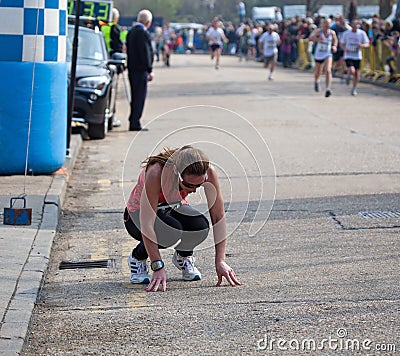
To me, this is like that part of the marathon, where the runner just wants to give up, where they can't imagine running even one more mile. Some quit, but others just keep going and before they know it, they're crossing the finish line.
Exhausted Runner

That is where I am right now, where my family is, and from what I can tell, where our nation is too. We're all at mile eighteen and there are eight more long miles to run. Our legs are weak and burning, our sides are cramped, we're gasping for breath and we can barely take even one more step. We keep eyeing the curb or the shade of a tree and thinking how easy it would be to collapse there and rest. Forget the race, we'll just walk home later, alone. To keep running is too painful. We need to remember, this is not the time to stop. We're not at the finish line yet, and we didn't set out to run part of a marathon. This is simply not the time for us to quit. Rather it is time to dig deep and find resources we never knew we had. It is time to remember why we entered this race in the first place. It is time to push ourselves through to the finish line. Even if we're the last runners on the course and no one is waiting at the finish, none of that matters, because even if the finish line is deserted and all cleaned up, our prize WILL be there. That is the perspective I'm going to take.

So along those lines, I'll say, Tara, I love you with my whole heart and my whole being. I know we can and will be happy if we can get through this tough time. I know I am tired and irritable and intimidating. I am trying to figure out how to address those things and I will find a way to succeed, I promise.

To Rowan and Devin and Mikalh, I'm so sorry for the lack of patience I've had with you and I'm apologizing now for the inescapable times I'll have a complete lack of patience with you in the near future. This is not the person I want to be and I am trying to become better. Please remember that I love you completely...I love you more than you can imagine.

Everyone, please forgive me for my arrogance, my short temper and my sometimes dismissive attitude. I never meant to hurt you and I'm working to do better. Please know also, that I do and will forgive you for what ever there is that I should. Not because I'm some great person. I assure you I am not, but simply because we are family and that is what family does, when they love each other, they forgive!

I love you all!

Wednesday, August 15, 2012

Kelly Let me Post on Her Site! - @Southern Fried Children

Kelly over there at Southern Fried Children - http://southernfriedchildren.blogspot.com/, let me guest post on her blog today!

If you've been following my auto-biographical story about leaving Albuquerque, this is the next installment. The one when I land in California.

While you are there, you should stop and read some of Kelly's writing, She is fantastic and I am so honored that she is posting one of my stories on her blog. She is one of my favorite writers and I think she'll be one of your favorites too!

Sunday, July 29, 2012

Interdependent Existence: Our Blessings and Our Curses

--by Mike Adams

Delivered July 29, 2012 in Rio Rancho, NM

In our seventh UU principle, we covenant to affirm and promote...”Respect for the interdependent web of all existence of which we are a part."

What does that mean to you? Look around, everything you see or feel, the air you breath and the chair where you sit is composed of stardust. That stardust was created billions of years ago by supernovae. It was a time before life or water or planets. A time, when energy danced through the cosmos making stars and morphing into matter. A time of energetic creation, which truly is the beginning of our story. It is the root of our interdependent nature, an interdependence which exists not only on a physical and biological plane but also ontologically between our achievements or success and the suffering others have endured unjustly. I don’t necessarily mean the results of our nation’s ill deed as in legalized slavery or the genocide of Native Americans. Rather, I refer to the unseen interdependence, the byproduct of another person’s misfortune, which improves our lives. The tragedies in which we never participated, but somehow they made us who we are. According to Blaise Pascal, “The Least movement is of importance to all nature. The entire ocean is affected by a pebble.”

I recently attended a UU service in Cambridge, MA. The result is that I have been contemplating this UU principle of interdependence ever since. Rev. Mark Morrison-Reed delivered one of the most profound and moving sermons I have ever heard. I arrived there quite by accident. The previous night, I had searched the Internet for UU services in Boston and I was drawn to this one. The topic and the guest preacher sounded intriguing. Rev. Morrison-Reed is one of the few African-American ministers in Unitarian Universalism and he has written extensively about the experience of African-American UUs. But what really drew me in, was his topic for a Sunday sermon. It was a topic, which reached across this great country, and touched my hometown of Los Alamos, NM.

Rev. Morrison-Reed's father had been one of the first African-Americans in US History to be hired as a scientist. Apparently, the US war effort during World War II, opened many doors for African-Americans and the Reverend’s father walked right through one of those doors and joined the Manhattan Project as a chemist. The result for young Mark Morrison-Reed was that opportunities became available to him as a youth, which were out of reach for most African-American kids of his day. His education and life path were possible because of his father’s profession. So when, Mark began contemplating the human tragedy that resulted from the atomic bomb. When he realized that his father’s success was tied to that creation, he was troubled. Years later, the Reverend traveled to Hiroshima, on a pilgrimage to make peace with this specter from his and his father’s past. He went to confront the horror and to offer apology to those lost souls who had suffered a nuclear storm. His story was insightful, emotive and thought provoking.

It was at least one full day before I really began processing the poignancy of Rev. Morrison-Reed's message. During his sermon, I sat transfixed, tears gently gliding down my cheeks, each word infusing itself into my emotional and intellectual life. Time evaporated and for a moment, I was transported, I had the profound privilege of sharing another person’s spiritual quest and as the Reverend described his moment of redemption, I too was set free.

Several days later, it occurred to me that in some very important ways, my life mirrors that of Rev. Morrison-Reed. I was struck by the absurd complexity and nuance of existence. I was humbled by the incredible depth and profound nature of covenanting to affirm and promote the interdependent web of all existence.

I thought of my mother, a full blooded Canadian Indian. She was kidnapped as a young child by the US Government from a Seattle hospital. She was placed into foster care, where she endured violence, neglect, and abuse. As a youth, she was adopted into a family, which provided for her physical and educational needs, but affection was a rare commodity. As a young adult, she attended college, and married a man who later became abusive. She also gave birth to me and to my sister. As I thought about her life and all that she had endured, I suddenly became acutely aware of the fact that my life is possible only because another innocent human being was forced to endure unimaginable torture and suffering.

Had my mom been allowed to grow up with her Canadian Indian family, she would have been loved and cherished. She would have been the eldest sibling in a large family, where she would have played an important role in tribal life. A talented, intelligent and loving person, she would have been an asset to our tribe.

However, she might never have gone to college. She certainly would not have grown up in Santa Fe, or become a LASER technician at Los Alamos National Laboratory. She would not have addressed a group of Native-American students about technology and inspired one to finish college and become a science teacher. Most pertinent to me, however, neither my sister nor I would ever have been born.

So my life, my sister's life, the lives of our kids, and possibly the lives of countless Navajo youth who learned science from a woman, my mom had inspired are possible only because of my mom’s sacrifice. She is a woman whom I love unconditionally, whom I admire and revere. A woman who sends care packages to our service men and women overseas, who volunteers her time in our local schools, who has taught Religious Education for more than fifteen years. She is a beautiful and kind person, whom I love completely. So it pains me to know that she had to sacrifice her childhood in order that I might live.

How does a person make peace with something like that?
"Respect for the interdependent web of all existence of which we are a part."

It occurred to me that this interconnected relationship between success and tragedy is everywhere. The fabric of our existence, of our country's success is filled with strands of achievement that were purchased by another person’s loss. UUs are quick to applaud the courage, sacrifice, and accomplishments of civil rights heroes, of abolitionists, of those who ran the Underground Railroad or worked for women's suffrage. But we often forget to pause, to remember, and to respect the unwilling sacrifices forced upon millions of nameless victims. We forget that our lives are built not only on the courage and effort of our heroes but also on the shoulders and terror of all those anonymous victims who lost everything. We are the inheritors of their legacy too, and we owe it to them to remember their sacrifice.

During World War II, Nazis tortured and murdered between 11 and 17 million people. By 1945, two out of every three Jews from Eastern Europe had been killed in concentration camps. Additionally, there were millions of others, including homosexuals, disabled people, Pentecostal believers and political dissidents. This world was filled with survivors who had lost everyone they had ever known. They had been forced to watch as their brothers and sisters, as their parents and their children were systematically worked to death. Deprived of adequate food they labored past human capacity and were killed. For years, the survivors had daily inhaled the smoke and fumes of Nazi ovens, burning the remains of their fellow victims. They lived and slept with this horror, and when liberated, they returned to this world alone, having lost every person they had ever known or ever loved. How often, we forget that the holocaust was a major contributing factor to the conditions that allowed the US to enjoy a position of global leadership after that war. We may not have condoned or participated in that evil, but we certainly benefited from it.

Some of you may be wondering why I am talking about this on a beautiful Sunday morning. Why would I introduce such ugliness and negativity? Don’t people come to church for inspiration? Maybe, but there are some people like me, who actually come here for the free coffee...

I also come to church, because I am inspired by our seven principles. I believe that when we covenant to affirm and promote the interdependent web of all existence of which we are a part, we also covenant to speak those forgotten tragedies aloud. We covenant to bear witness to the horrible cruelty which humans can inflict. We covenant to acknowledge that our success is intimately tied to and dependent on the horror of someone else’s life.

Unitarian Universalism has always stood for those who lack power and who need a voice. We have always stood for those who are not the heroes or the freedom fighters, but simply the victims. Today's sermon is not so much a call to action, but rather a reminder that we have promised to remember with deep reverence, those forgotten and frightened people. We have promised to remember their unwilling contribution to the creation of this world. We have promised to respect the interconnected nature that their lives played in all of existence.

People's’ reactions to this sort of truth vary. Some may choose to dedicate their lives to peace. Others may decide life is short and unpredictable--that they need to ensure their friends and family feel loved. Some may be fidgeting and thinking, “I can't wait till this guy stops. The coffee wasn’t worth it today." Another person may simply feel moved and contemplative, there are countless valid reactions.

But I ask that you set those aside and join me now.
Take this moment to be silent and remember.
Remember the child, neglected and abused,
or the child who watched as their family was killed.
Take this moment to breathe and to mourn,
to mourn their suffering and horror and pain.
Take this time to experience life,
and give reverence to those who were sacrificed.
To honor their contributions to our lives and to all that we know...

In closing, I’ll quote D.H. Lawrence, “I am part of the sun as my eye is part of me. That I am part of the earth my feet know perfectly, and my blood is part of the sea. There is not any part of me that is alone and absolute except my mind, and we shall find that the mind has no existence by itself, it is only the glitter of the sun on the surfaces of the water.”

Friday, June 29, 2012

GBE2 - Week 58: Strength, a Tale of Eric and Joe

--by Mike Adams

Eric wondered if it was a general lack of good sense or the deprivation of oxygen that had caused his little brother to act so erratically. In truth, the little monkey was acting deliberately. He only wanted to see what his older brother would do in a situation that broke all the rules of Eric's rational world view.

Despite being separated by a seven year age gap, living at opposite ends of the personality spectrum, and sharing no physical characteristics that might indicate familial relations, the two brothers had a deep affection for each other. Secretly, the older envied his younger brother's curious bliss. He wondered, sometimes, if perhaps they weren't actually related. Not that it mattered, his love for the little bug was incredible and though his personality was an outlier in this family, he truly loved every member. His only complaint was that he often felt alone, not due to any lack of being shown affection, more because he was so distinct. He came from a different mold and he felt on some subtle level like a complete outsider.

For years, his cheeks would flame as embarrassment possessed him when a parent reprimanded him for being cruel. He meant no harm, he simply failed to consider that blunt honesty might actually hurt someone. His personality was a synthesis of unemotive computational logic delicately covering a subtle and insipid rage.

He was brilliant, but couldn't understand many of the most important and basic social rules in life. Rules that his younger brother seemed to grasp without effort. The other thing that really struck him about the little guy was his sense of justice and overwhelming compulsion to stand up for what is right regardless the possibility of negative consequences.

As a toddler, Joe would stand defiant against anyone, who he perceived as perpetrating injustice. Joe would affect a look of defiance and place himself between older and larger warring parties. He would hold his hands up, look at everyone involved and say, "You stop that! I don't like it when you act that way, quit being mean, NOW!" Usually the intensity of his ire and the smallness of his demeanor would cause everyone to laugh and say, "OK Little Mister, I'll stop."

This kid, nicknamed "Bear," seemed an anomaly to Eric, who had a difficult time mustering the courage needed to intervene in bullying. If he could bring himself to act, people would listen, there was no doubt. He was generally well liked, and despite his unusually small size, there wasn't a person in the school, who could provide a physical challenge to him. He was fast, strong and had years of martial arts training under his belt. No one wanted to mess with him and he knew it.

So why then, couldn't he intervene as his little brother did? Where did this kid's courage come from?

Was he destined for greatness or for heartbreak? Would his idealistic little brother go forth and change the world or would the world crush him? Eric had no idea, but he hoped that his brother would triumph. Eric always liked an underdog and somewhere deep inside, he believed that Joe the Bear might possess some secret strength that no one suspected.

Tuesday, June 26, 2012

I'm Leaving Town, but Where Will I Go?

--by Mike Adams

Continued from:
Part 1 – Something Had to Change
Part 2 – In Search of a Plan
Part 3 – From Sandia Peak, a Plan is Born

Next day, I awoke, to an unusually warm environ. The sun’s light glared menacingly at me from every angle, such that I had to squint and cover my eyes. Flipping over onto my stomach, I lay there, like road paint melting into the highway on a sweltering summer day. “Wait a second,” I said, “the sun never hits my room before 2:00 pm.” I looked at my clock, which read 3:45, “Shit, I never sleep past noon!”

I struggled to free myself from the bed. The sheets adhered to every inch of my anatomy, glued by gallons of sweat, which had poured from my body as I slept in the afternoon sun. “Oh Crap, there better be some left over coffee, I can’t possibly brew or drink hot coffee now!” I walked towards the kitchen, “how am I going to leave town, when I sleep till 4:00 pm?”

This last statement stopped me cold, “Whoa! ...It’s already starting!”
I tended towards reversing course a day or two after making big decisions in life. I’d wake up and notice the general incompetence with which I managed my affairs, and then guided by terror, I’d change my mind. I had done this and regretted the outcome often enough to be fully aware of what was happening. I wouldn’t allow it, not this time. The previous night’s decision was important. I had a sense that backing out would be a terrible mistake.

Up to this point, I had been incredibly fortunate while searching for jobs. I was always offered the first for which job I applied and every job I had found was recommended by a friend. I had never searched the employment section of a newspaper. I’m not sure I knew it existed.

Where should I go? I began considering the important questions, how many single and attractive females live there? Is the music scene eclectic? Will the political climate suite me? Is there good hiking available?

Worry about finding a job and a place to live tickled the base of my skull, but I refused to entertain any serious thoughts about those topics. Reality, it seems, would have to wait. It could attack my psyche in a new city, but not now.

I snorted aloud to myself, “How hard could it be to find a job? I’ll work in a Hotel, they’ll be lucky to have me. And finding a place to live? That is simple! I’ll find a really cool place and live there!” The idiocy with which I considered the basics of survival leaves me a bit queasy even twenty years later.

After thinking about what I knew of various cities in terms of the questions I decided are important, I decided on San Francisco. I figured there have to be beautiful and single women everywhere. I could become a bicycle messenger and maybe start a racing team. More importantly, however, I had a friend who was living with his parents near San Fran., he’d probably let me stay there for a month or two.

I phoned and explained my plans, then asked if I could stay with him until I was situated. He said "sure Mike." I urged him to check with his parents, and avoid surprising them. He said, “Don’t worry, it’ll be fine.” Retrospectively, he couldn’t have believed I’d actually move. I had repeatedly threatened similar actions in the past and never gotten past Colorado Springs. To anyone who knew me, the possibility of my moving to California was remote. His affirmative answer was, therefore, neither considered, nor based on a realistic sense that I might knock on his door expecting a place to stay.

My employer was unhappy to lose me, but probably a bit relieved as well. They were always one full pay cycle behind, so I planned on saving two paychecks to fund my move, and receiving one more in California to help me get started. I failed to consider my own inability to manage finances. I had several “going away" parties, where I was the only celebrant and one week later, my whole paycheck was gone. Next week, I received a second infusion of funds, and I threw another party. Everyone was invited, so the next morning, when I awoke, paycheck number two was GONE! I’d have to wait two more weeks, and with my final check, I’d leave.

Two weeks later, I was packed, my bike was tuned and I was ready to go, but having been sober for almost two weeks, I couldn't resist throwing one last party. I want to “leave in style,” and I hoped Sarah might want to spend a passionate evening in my arms. Next morning found me alone and ...broke! I was moneyless, unemployed, and thoroughly humiliated...AGAIN!

I asked Mom for help and she came through with $200. I hugged her and said “good bye, I love you.” She began crying, “I’m worried about you. Why do you want to move so far away? I won’t be close enough to come if you needed help. I don't want you to get hurt.”

I froze, as guilt and shame suffused my being. Seeing my expression, mom hugged me and smiled quickly, “I understand, you need to find your way, to grow up! All moms want to keep their kids safe. You better get going, before I start crying again. I love you, please be careful!”

I climbed on my 1972 BMW R75 motorcycle, perched my helmet on my head, a nod to my Mom's concern for safety, started the beast and headed for the edge of town, where the helmet came off. I rode West, into the sunset, a grin on my face and a feeling of weightless glee in my gut. The sunset was amazing and it seemed to last for ever, as I chased it into the middle of Arizona. The wind tossed my hair and I imagined the glory ahead of me as I charged into my future soaring above humanity as a falcon, released from the zoo.

…Open up that Golden Gate, California Here I Come – To Be Continued...

Tuesday, June 12, 2012

Compassion & Controversy: A Message for Unconditional Love

--by Mike Adams

The past few days have seen a swirl of activity and discussion regarding homosexuality, same sex marriage and morality. We have seen myriad responses calling for tolerance or alternately for "tough love", we have continued to be assaulted by people, whose message is closer to that of Fred Phelps than a loving and compassionate Christian. We have seen Glennon over at Momastery publish some beautiful prose, eloquently showing the depth of her introspection and her devotion to a Christian doctrine of love over intolerance. We have seen Josh Weed publish a "Club Unicorn" post, in which he announced to the world that he is a homosexual man, who has chosen to marry a woman, to have children and to live a prescribed Mormon life. His message and that of his wife is a profound expression of love and it earned them a warm and supportive response from thousands.

We have seen comments aimed at Glennon questioning or denouncing her Christianity, while others have claimed that Josh Weed can't possibly not gay. Stones are being whetted and axes are being sharpened, but out of it all, what I'm left with is a message of love, a message of tolerance, and a message of hope for humanity's future. I stand in awe at the beauty of what these people are promoting. I am inspired by my wife's post "Something is Changing," and the incredible responses she has received from her readers. I am humbled by the ever louder affirmation and promotion of every human being's inherent worth and dignity, by the incredible message that all of these beautiful authors have articulated it so eloquently.

They have set a high bar and one, which I am unlikely to clear, but I am going to add my voice to this conversation anyway. I am going to try and stretch myself to meet the level and quality of discourse already taking place. Though I am articulate and loving, compassionate and caring, I am also arrogant and self righteous. I am a deeply flawed person, who tries to be good and to do good in this world, but often I fall short. I keep trying anyway and sometimes I succeed, despite myself.

So for anyone who reads my posts here or my comments on Momastery, my conversation on TED, my responses on Faith in Ambiguity or my challenges on the Huffington Post, I know that what I say often occurs as "in your face," or "righteous indignation." And for that I apologize. For those, who need an able and convincing ally; I apologize, because though my heart is in the right place, my passion and sense of justice may harden my words and sharpen my tongue, leaving my message hard to hear for people who disagree.

I am an imperfect messenger, with a small audience; however, all of my readers are incredible people. They are better than I am. I believe they reflect the potential of who I might become. My hope is that despite my obvious limitations, despite my arrogance and indignant nature, I can inspire them to shout this message of love to the world from their pulpits and blogs and personal conversations. I am going to try, and as Glennon once said, this is a mountain I am willing to die on. It is a cause I am willing to fail at over and over again, until I get it right.

I will not give up, because I love YOU so much, because I love my children so much and I love humanity so much.

To start, I want to address anyone I have personally known who is gay and who has suffered this society's intolerance. I want you to know that I LOVE YOU. Maybe I failed to stand up for you when you were being bullied and later, I tried or perhaps I failed to offer comfort. If either is the case, I apologize for letting my fear paralyze me when you needed me. But know this, you are my brothers and sisters and I Love You! I am imperfect and ineffective, but I promise to do what I can to transform this world such that you feel valued.

To anyone who is secretly gay and hiding, because your family and friends have made it clear that they think being gay is vile. If you feel alone and frightened, if you feel depressed or suicidal, if you feel like no one cares. If you fall into any of these categories, I hope that you may find message, because you need to know that I LOVE YOU! I think you are beautiful and important and valuable. Though we haven't met, you are my brother or my sister and you are deserving of love and support. Please leave a comment or send an email. I'll be happy and honored to be your friend. mla_ca520 at hotmail dot com.

To anyone who is struggling with your faith and your personal sense of morality. Perhaps your church believes and tells you that homosexuality is wrong and that YOU need to condemn it. Perhaps you disagree, but choose to stay quiet, and wish you could stand tall and openly speak your mind. I want you to know that I Love you too. I have lived with that kind of fear, the fear that kept me from telling people to stop being cruel when someone was suffering. The fear that prevented me from stopping bullies as they tormented my friends. You are in a difficult place and I know you will find your power if you keep searching. In the mean time, please remember that I Love you!

To anyone whose heart becomes cold to this message, who is tempted to leave a comment condemning me or those who agree with me. We may disagree, I may say harsh things to you as my passions get stirred, but on a fundamental level, you should know that I Love you too. You should know that I will fight with the same passion and tenacity for you to have your personal and religious freedoms as I fight now for our gay brothers and sisters. I know that you are a human miracle, the unlikely transitory product of a marvelous and intricate evolution, which has unfolded for billions of years. You are my brothers and my sisters and I love you. I know you believe you are trying to save my soul and the souls of others whom you condemn and though I think you are misguided, I am grateful that you care enough to try and I love you.

Finally, to my brothers and sisters, who stand with me on this side of the controversy. To my beautiful and talented wife, to Glennon and to Josh Weed, to the UUA and the UCC. To anyone who has taken up this cause and decided that you will stand on the side of love. Thank you and I Love you too. I thank you for helping me to find my courage and my voice. I thank you for helping me as I strive to join your ranks and become an effective advocate for what is good and right in humanity. I thank you, not for your tolerance, but rather for your unconditional love and your compassion. You are my heroes!

Friday, June 8, 2012

Guest post by B's Stings on Growing up Unitarian

Today's post is a guest post and video featuring my talented, helpful and much loved mother-in-law, B. If you haven't seen her blog, please take a moment to check it out, but be sure to come back and see what she has to say about Growing up Unitarian. Perhaps more importantly, about growing up with a famous father and a revered mother. The video and the read are both fantastic, so you should feel free to pick one or both. Her Blog: "B" Stings


Growing up Unitarian
--by Bronwyn (B) Gordon

From a very young age I understood that the church I attended was different from most people’s religious institutions.  For one thing, I was usually the only Unitarian in my class at school. To be honest, I didn’t appreciate this distinction. I already had an odd Welsh name that no one had ever heard of or seemed able to pronounce. Plus, I was painfully shy, so shy in fact that I had spent most of kindergarten hiding under the grand piano. In my world, to stand out was to invite ridicule.


There was Sunday, of course – the one day out of the week when I might mingle inconspicuously among my own kind.  You’d think so anyway but, as it turns out, I was an oddball at church too. This was because my father was the minister – not just the minister either, but the celebrated A. Powell Davies who spoke out eloquently against Joseph McCarthy’s red baiting and racial segregation, who was invited to be on shows like Face the Nation, and got quoted on a regular basis in the Washington Post.

Because of my father’s celebrity, I was frequently waylaid in the halls of All Souls Church by various ladies who crushed me to their ample bosoms and told me how lucky I was to have a father like that. Male church goers looked me straight in the eye and dared me to live up to the high standards of my father’s courage and eloquence.

I did not want to live up to anything. I just wanted to be normal.

All Souls Church, situated in downtown Washington, D.C., was modeled after London’s St. Martin’s- in -the -Fields replete with a classical style pediment supported by Corinthian columns and  endowed with an impressive bell tower that we Sunday School children were invited to explore once a year. The church had a big auditorium plus balconies on either side and it was always filled to capacity. There was a professional organist as well as a professional singing quartet. My father ascended and descended the raised pulpit with regal solemnity.

At All Souls church,  services were formal and dignified. Ladies wore hats with veils and men wore suits. I was obliged to wear frilly, elaborately smocked dresses and patent leather shoes that drove me nuts all morning by trying to eat my socks. At the end of the service everyone recited The Lord’s Prayer even those who didn’t believe a word of it. This was, as I recall, a concession to certain elderly long-term parishioners. I’m certain my father didn’t approve of sentiments such as “Lead us not into temptation” but he chose his battles wisely.

Various political big shots attended church services from time to time.  Included among these were Senator Paul Douglas, Supreme Court Justice William O. Douglas and two-time presidential candidate Adlai Stevenson.

In Sunday school we read about two kids named Martin and Judy and pondered the moral conflicts plaguing preschoolers and kindergartners. Later we read Jesus, the Carpenter’s Son and I concluded that, overall, the protagonist was a pretty stand-up guy.

I also learned that Christians were self-deluded people who believed that Jesus lived with God up in the sky. As for God, Himself, it turned out that he probably didn’t even exist, at least in the sense of the grandfatherly persona most of my classmates prayed to. Apparently, if I wanted to get my wishes granted, I needed to acquire a fairy godmother or discover a magic lamp.

Due, in part, to outspoken  contempt on the part of some of my Sunday school teachers, I was sometimes inspired to insult my god-fearing friends and classmates. Predictably, they, in turn, informed me that I was destined to burn in hell. I did not believe them but I did (on reflection) regret having hurt their feelings.

All that said, I did grasp something positive in the nature of Unitarianism. For instance, I understood that Unitarians stood for justice for all people not just for rich white people.

In this context, let me explain that All Souls was (and is) an inner city church and that the presence of African-Americans among the members of its large congregation was unremarkable. In my teens, I belonged to a drama club formed by some of the kids in my Sunday School and we regularly  performed plays with “color blind” casts.   I was aware, also, that when my father was called to the pulpit of All Souls, he stopped the Church from renting space to the segregated Police Boys Club and invited the integrated Columbia Heights Boys Club to take its place.

When  Brown vs. Board of Education of Topeka Kansas reversed the Supreme Court ruling of Plessey vs. Ferguson, my father celebrated this triumph from the pulpit. After that, we began to receive threatening phone calls and I remember I was not allowed for awhile to answer the phone. I understood that taking a stand, even in the face of murderous opposition was something Unitarians valued. Later, while serving as assistant minister at All Souls Church, the Rev. James Reeb  risked his life in the cause of civil rights and was murdered in Selma, Alabama in 1965.

I was thirteen years old when my father died. For awhile I continued to attend All Souls Church, especially the drama club. At some point I became aware that new churches were being founded, most, if not all, in the upper middle class Maryland suburbs. In these new churches (one of which was founded by my mother) there were hardly any dark faces. There was also less talk about social justice and more discussion about breaking the yoke of Christian dogma.

When the sixties hit, many Unitarian parents underwent a sort of test of hypocrisy. As their sons quit college and decided to take up organic farming and their daughters went around braless and marched in peace rallies, mothers and fathers protested that this was not what they had meant when they had celebrated non-conformity.  To sympathize with farmers was one thing, to actually be one quite another.  This conflict inspired my mother to preach a sermon entitled, “Did We Really Mean It?” in which she challenged the congregation of River Road Unitarian Church to respect their children’s right to choose.

Like my father in this regard, my mother fully demonstrated the courage of her convictions.  She stood up for what she believed even in the face of overwhelming opposition. Throughout her long life she was as faithful to her values as it is possible for a human being to be.

As a young adult I was more interested in Hinduism, Zen Buddhism and Native American spirituality than I was in Unitarianism. I moved a long way away from my childhood home, married and gave birth to a daughter.

When my daughter was five or six, I returned, briefly, to the fold. The church I attended on the West Coast was radically different from the one I’d grown up in. For one thing, it wasn’t even a church. It was a Fellowship and determined to remain one. The congregation was small and consisted largely of senior citizens. The Sunday school was even smaller and attendance there was erratic.

This church – or rather fellowship – went through ministers like a teacher goes through chalk. Some of the ministers were into improv, so you never knew what might take place during the service. One of them was inspired to perform the dance of Shiva  and cavorted around the auditorium wearing what looked like loose-fitting cotton pajamas. Another minister spent twenty minutes tossing a football to various randomly-selected congregates.

Really the only thing these Unitarians had in common with my childhood version of Unitarianism was a sense that many of them had of having suffered some sort of trauma due to their Christian upbringing. Since I was not brought up Christian, I have no understanding of this experience. In other words, I was more or less deprived of God not bludgeoned with him.  Was it Emerson or some other self-appointed critic who said that Unitarianism was “a featherbed for falling Christians”? I  began to wonder if this, more than moral courage and  a dedication to  social justice, formed  the common  UU ground.

When this congregation voted overwhelmingly to sponsor illegal aliens fleeing from the repressive regime in El Salvador, I was relieved and even proud. Flaky  though they were, they did, in fact, have the capacity to take a stand against injustice.

Soon after this action, a conflict occurred between the minister and the RE director. The congregation took sides while reason and compassion were overwhelmed by righteous indignation. Eventually,  part of the congregation split off and established a new fellowship.  I attended the new fellowship briefly then quit altogether.

I became increasingly absorbed by my work in special education which profoundly influenced my spirituality in ways I can’t begin to describe. One of the teachers I worked with was a Mormon who, without piosity or pretense, devoted herself to living what she called “a Christian life.” Ironically, I learned more from her about respecting each individual’s worth and dignity than I did anywhere or from anyone else.

I am not suggesting that my particular experience in the UU denomination has much, if any, correspondence with (for wont of a better phrase) “the truth about Unitarianism.” This is partly because I wasn’t just another Unitarian.  The pedestal of fame on which my father stood increasingly began to feel, for him, more like a tightrope. His fear of falling (i.e. failing to live up to the adulation surrounding him) resulted in his making some unfortunate choices that had negative consequences for him and for his family. Thus, my sister and I, rather than becoming replicas of our father, ended up dedicating our energies simply trying to survive . I succeeded (in surviving, that is) but my sister did not. Her children – my niece and two nephews – though they attended Unitarian Sunday School -have no interest whatsoever in Unitarianism. My oldest nephew regards Unitarians as cocktail party liberals and my other nephew regarded my mother’s idealism as naïve and cute. While I don’t necessarily agree with them, I understand why they feel they way they do.

My  daughter’s perspective on Unitarianism is, however quite different. Inspired by a Sunday school curriculum that focused on freedom fighters, taught by a dynamic teacher, she walked, one day, into the local peace center and offered her services at the age of eight. She and her husband continue to explore the issues of spirituality and social justice within the context of Unitarian-Universalism. My grandsons, too, have a strong Unitarian-Universalist identity.

As for myself, though I don’t define myself as a Unitarian,  I still have the utmost respect for my parents and what they stood for.  Their vision of Unitarianism was that it be a powerful force for justice, compassion, and peace in a troubled world. They did not place much value in semantics, nor did they bewail their conventional Christian upbringing.  They believed that each individual, however flawed his personal life might be, was capable of placing the common good ahead of his own self interest. That, I think, is the part of their legacy that is worth living up to – not just for their descendents, but for all of us.

Wednesday, May 30, 2012

I don't like your motives ...well, not the ones I've decided you have!


--by Mike Adams

Wednesday, May 9th was a day much like any other. I woke at 5:45 in the morning, sat in a semi-catatonic state sipping coffee and trying to get my bearings. As usual, I insisted that my feeble mind square itself with the day, an often futile exercise. I ate breakfast and left for work, where I answered calls, fixed computer problems and then returned home exhausted. That evening, I sat reading the NY Times email digest, when my attention was drawn to a rather spectacular headline. Thinking it a mistake, I clicked the link and read the following quote from Barack Obama, "I have to tell you that over the course of several years as I have talked to friends and family and neighbors when I think about members of my own staff who are in incredibly committed monogamous relationships, same-sex relationships, who are raising kids together, when I think about those soldiers or airmen or Marines or sailors who are out there fighting on my behalf and yet feel constrained, even now that Don't Ask Don't Tell is gone, because they are not able to commit themselves in a marriage, at a certain point I’ve just concluded that for me personally it is important for me to go ahead and affirm that I think same sex couples should be able to get married."

With a smile, I turned to my wife and said, "Wow! Did you know Obama endorsed same-sex marriage today?" "Yes," she replied, without looking up from her blogging activities. But I sat there stunned and glad for the change. The next few days saw rampant speculation about the President's timing, about his motives and about the political implications of his actions. But nothing anyone said had the ring of truth. The commentary was pure speculation, peppered with guesswork all wrapped in responsible language trying to masquerade as fact.

Obama had offered a simple explanation for his decision. I suppose his words lacked sensationalism, so our media had to generate engaging reasons for his decision. None were insightful, mostly they were a gage of our society's tendency to ascribe motive as a means of gaining political advantage.

This sermon is about exactly those kinds of motives. The kinds that people attribute to others without knowing what we are talking about. The kinds of motives that we create in order to know which category someone belongs in. In order to determine how carefully we should listen, if at all.

As with most of my sermons, today's talk was inspired by a conversation I had with my wife. Several months ago, she told me that I often attribute motives to her, which aren't her actual motives. I was flabbergasted.

"What?!" I stuttered, "I attribute wrong ...motives?!"

I like to think of myself as being unusually insightful and I'm not particularly fond of having someone point out my mistakes. I prefer, instead, to identify my own shortcomings and then highlight them for others. That way, I can bask in the warm glow of my own self-enlightenment. But she was right, again. I did not know what her motives were and I usually didn't ask. This insight, though annoying, caused me to consider how often people attribute motives to others without actually knowing.

Immediately, I thought of national dialogues concerning same-sex marriage, the war in Afghanistan, pro-life/pro-choice, deficit spending, pro-union/pro-business, race relations, feminism, education and parenting.

Indeed, our media, our politics, our religious conversations and even our personal lives are inundated with alleged motives that may, in all reality, have little or nothing in common with the true reasons that actions were taken or things were said.

Let's consider marriage equality, is it a civil rights issue? Supporters say yes, they insist that any two people, who are old enough, should be allowed to marry. To them, prejudice is prejudice and free choice is free choice. Marriage equality is nothing more than observing someone's right of free choice, in an arena where it is currently being denied.

Simple and straightforward. This represents my sincere point of view. However, my philosophical opponents don't see it this way. In fact, many believe marriage equality supporters are servants of evil. They believe we are pushing a "gay agenda,” which will undermine the sanctity of a bedrock institution and which could tear our society apart. To them, supporters of marriage equality are minions of Satan, bent on destroying this great Christian nation.

Truth be told, THEY HAVE MY MOTIVES ALL WRONG!

But what about assigning motives in the other direction? What if we consider another topic like pro-life vs. pro-choice? I am pro-choice and my reasons for this position are similar to my reasons for supporting marriage equality. I believe in free choice and I feel a woman has the right to choose if, how and when her body is used, including for child birth.

On the opposite side of this controversy, we’ll consider my late Grandfather, who was a staunch Catholic. His pro-life conviction was steadfast. He was clear that aborting a pregnancy is tantamount to murder. He saw an unborn fetus as being no different than any person you might meet in this world. It was a simple matter to him, conception creates people, abortion kills people, killing people is murder and murder is wrong.

Simple and straightforward, I drew different conclusions from him, but I can respect his clarity. My Grandfather’s position on abortion did not make him misogynistic. I reject the notion that pro-life activists are primarily motivated by a desire to control women's lives and bodies. This may be true of some, but I’m convinced that most pro-lifers feel passionately that they are fighting to stop murder. I think they are bewildered when accused of being dishonest or nefarious. Honestly, THE LEFT HAS THEIR MOTIVES ALL WRONG!

These two examples demonstrate a broader problem. A problem, which prevents intelligent conversation, which discourages collaboration, and which undermines the creative power of controversy. I believe the most innovative ideas are spawn from controversy. That when opposing opinions clash, and intelligent dialogue ensues, we create fertile ground for the germination of new ideas.

But in our society, the required dialogue is missing. We hurl insults and categorize people as Nazis so as to insulate ourselves from having to consider their points of view. The soil that should nurture tomorrow’s solutions is growing fallow and most of today’s ideas are little more than a polished regurgitation of yesterday’s discarded plan. This is a concerning state of affairs. With global climate change, a dubious economy, rampant starvation, a growing population and shrinking resources, we face unprecedented challenges.

So what is the solution? That’s the hard part. Humans prefer simple answers, but today’s challenges are complex. They defy black and white categorization, they require thoughtful discourse, a nuanced approach, and wholistic thinking. We need to constantly look for where we are falling short of our own values. UU values include a free and responsible search for truth, promotion of the inherent worth and dignity of all people, and respect for the interdependent web of existence. Those are values, which could make a profound difference in today’s world. They are values that humanity desperately needs, and we could be their greatest champions, if we are willing.

But we’ll have to give something up. We’ll have to pay a price and that price will be our certitude. Ours is a religion, which ought to make room for everyone and yet there are very few African American UUs or Hispanic UUs or Native American UUs or Republican UUs. If we want our message to be vital, we need to reach these people and if we’re going to do so, we must stop thinking that we know what their motives are.

When we assume we know someone's motives, we excuse behavior, which is normally unacceptable. I used to rant that G.W. was a fascist and a Nazi. I was wrong! My wife’s paternal family is Jewish. One of her cousin’s parents lost everyone they knew to the horror of Nazi concentration camps. She has no grandparents, or aunts or uncles. Her parents have no life long friends. They were all murdered in Nazi Germany.

So using the term Nazi to describe anyone who isn’t engaged in the mass murder of millions of people is wrong! It is particularly disgusting when used to score cheap political points. The memory of those men, women and children who were lost during that genocide is worthy of a much greater reverence and respect than to be used for short term political gain or to discredit someone we simply don't want to listen to, because we dislike what they say.

If we’re going to change this world and leave it a better place, if we’re going to really promote our UU values at large. We’ll have to rise above such contemptuous foolery. We’ll have to elevate current dialogues to a level where change can happen, where innovation can flourish, where UU values can sow dreams, which might sprout and become tomorrow’s thriving harvest. If we’re going to create that world about which we talk to eloquently, we will have to abandon inflammatory language and try to gain an honest understanding of why people disagree with us. Otherwise we can’t possibly hope to reach them and we are sure to miss the valid points they make. We're sure to fail at creating the needed ideas for tomorrow. We're sure to short circuit the creative engine of intelligent disagreement, which will yield tomorrow's great ideas.

I believe the values this world needs can be found in our UU Principles and sources of faith. I believe we are the ideal people to promote those values in this world. I think the essence of our shared promise, our covenant to affirm and promote our seven principles is a call to action. I believe it is nothing less than a call for us to stand tall and challenge each other to climb higher, to champion our values with an even louder voice. I think we have a powerful legacy to uphold, that we are the culmination of generations who have struggled to realize these values in this world. We are needed, our message is needed and our values are needed. We've promised each other that we would promote those values and I believe this is the time for us to walk out into this world and shout our good news at the top of our lungs. To sow our dreams into the fertile ground of tomorrow for this world's future. To create the vision we have dreamed and manifest our beautiful vision for the next generation.

Tuesday, May 8, 2012

Follow this link!

Hi, My beautiful and talented wife has started an incredibly interesting conversation on her blog:
Ask Team Ambiguity: Are Women Enslaved by Modern Motherhood?

Please take a few moments to check it out and participate in the conversation. The one thing to bear in mind is that this conversation has rules...mainly, be respectful! The rest can be found here